
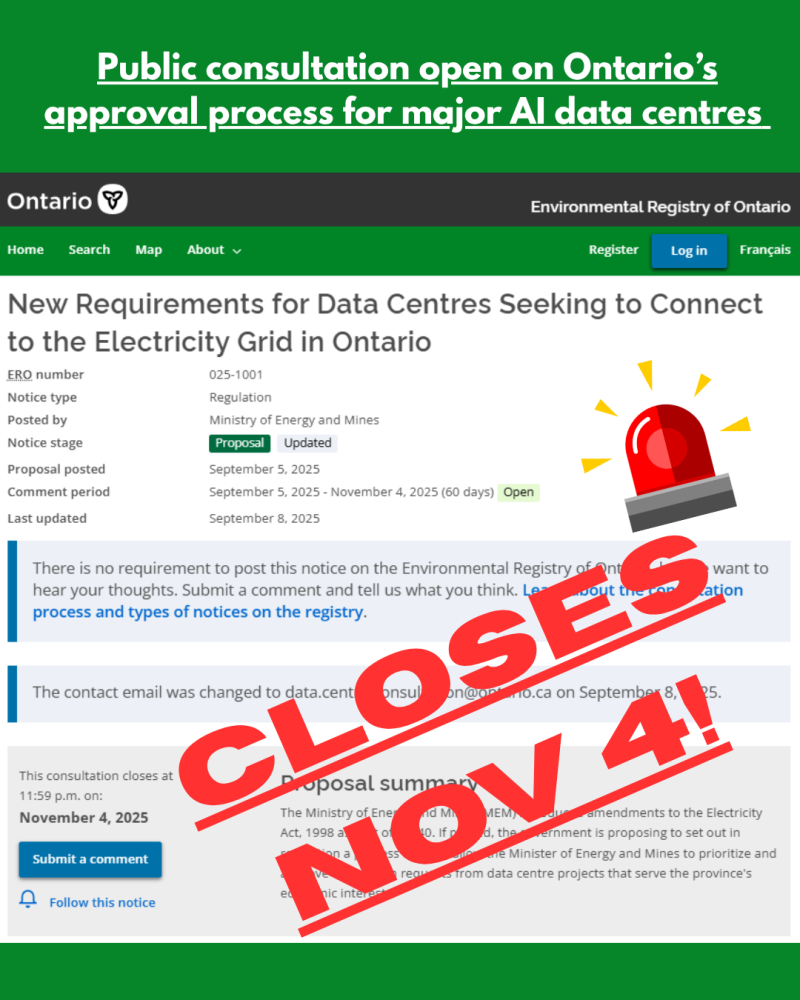
On November 4th, 2025, ClimateFast submitted a comment to the ERO on Bill 40. In total, 24 groups signed on to the letter and we heard from 92 individuals that supported the letter.
We also heard that the ERO site crashed from the large number of people going to the notice and trying to get their comments to the Ministry. Social media influencers such as Karishma Climate Girl stated that 23,000 people clicked on their Linktree to go the ERO notice!
AI data centres are a relatively new phenomenon that need to be seriously examined before being allowed to set up throughout our province. Their energy, water, and mineral footprints expand dramatically when large‑scale machine‑learning models are trained or served. The province needs to get feedback from and consult with a wide-range of people including local residents, municipalities, academics, climate organizations, human rights groups, computer scientists, and engineers to create a transparent and thorough review process for new AI data centres. The Province must also respect and honour the treaty rights of Indigenous Peoples at all times.
It should be also be noted that the questionnaire on the ERO was biased; most of the questions presume that AI data centres are only positive, that every community will want one, and that there are no downsides to their existence. The Ministry of Energy and Mines draft frames data‑centre development as an unquestioned benefit (e.g. using words such as “prioritize”, “encourage”, “high‑quality jobs”). The wording steers respondents toward affirmative answers while masking legitimate concerns. A genuine consultation would ask neutral, open-ended questions, instead of leading, loaded, or assumptive questions.
To read ClimateFast's full response to the ERO notice, see here.
Volunteer: To get involved in climate action and organizing around AI data centres in Ontario, sign up in the form here.
Tracking Bill 40: To check on the status of Bill 40, go to the bill on the Legislative Assembly of Ontario webpage. Under "Status", it shows where the bill is at in the provincial decision-making process.